
The HVAC system (Heating, Ventilation and Air Conditioning) is not just the heart of a cleanroom; it’s the guarantee of its certification. Incorrect design can invalidate the entire investment. Its function is to maintain a controlled, stable, contaminant-free environment, ensuring that the air meets the cleanliness, temperature, humidity and pressure parameters required by the ISO 14644 standard and GMP. Today we’ll look at how an HVAC system for cleanrooms works, its main components, and the aspects essential to achieving effective, certified environmental control.
What is an HVAC system for cleanrooms
An HVAC is a complex network of equipment that filters, conditions and distributes air, guaranteeing a particle-free environment.
Its goal is to meet the cleanliness levels established for each ISO class (from ISO 5 to ISO 9) and maintain constant environmental conditions, even in critical processes.
Unlike a conventional air conditioning system, HVAC for cleanrooms is designed to:
- Filter air using HEPA or ULPA filters.
- Control positive or negative pressure between zones.
- Regulate temperature and humidity within very narrow margins.
- Maintain laminar or controlled turbulent airflow.
Critical air control: HVAC functions for cleanrooms
1. Air filtration
Filters are the most important element of the HVAC system. Air passes through different filtration stages:
- Pre-filters, which remove large particles.
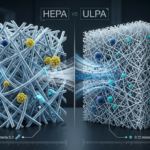
- HEPA or ULPA filters, which remove microscopic particles down to 0.12 µm.
This ensures that the air pushed into the room meets the corresponding ISO classification.
2. Temperature and humidity control
The HVAC system regulates temperature (typically between 18°C and 24°C) and relative humidity (between 45% and 60%) to prevent condensation or electrostatic discharge.
These parameters are crucial for maintaining product stability and staff wellbeing, as well as preventing thermal changes from affecting internal pressure or airflow.
3. Differential pressure
Cleanrooms are designed with a differential pressure system to prevent the entry of contaminants.
- Positive pressure: air flows outward (used in sterile or production rooms).
- Negative pressure: air enters from outside (for biological containment rooms or handling of hazardous agents).
HVAC is responsible for keeping these pressures stable through automatic valves and sensors.
4. Air changes and flow rate
The amount of air circulating through the room depends on the ISO level. For example:
- ISO 5: more than 240 air changes per hour.
- ISO 7: between 60 and 90 changes per hour.
The HVAC system guarantees this constant flow rate to remove particles and maintain environmental purity.
5. Airflow distribution
Filtered air can be distributed in two main ways:
- Laminar flow: unidirectional, uniform and turbulence-free. Ideal for critical zones.
- Turbulent flow: multidirectional, suitable for less-demanding areas.
The type of flow is defined in the initial design and determines the configuration of diffusers and return grilles.
Main components of the HVAC system
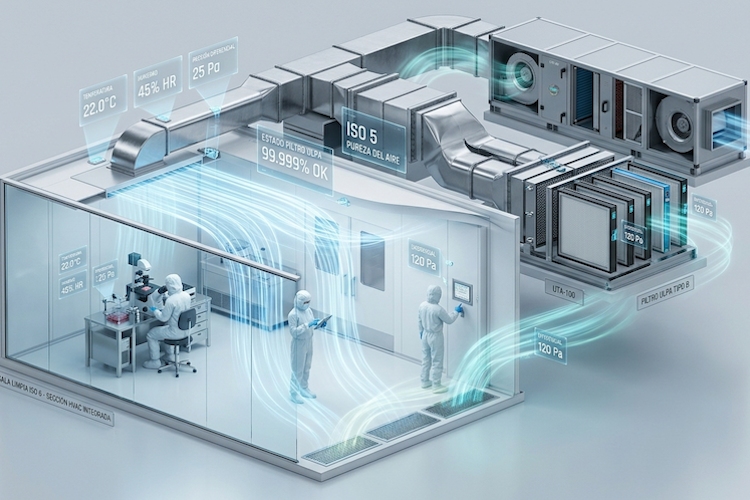
A complete HVAC system for cleanrooms includes the following elements:
- Air Handling Unit (AHU): the heart of the system, where air is filtered and conditioned.
- Supply and return ducts: distribute clean air and collect used air.
- HEPA/ULPA filters: located at supply terminals or modular ceilings.
- Fans and compressors: ensure constant airflow.
- Heating and cooling systems: regulate temperature.
- Humidifiers/dehumidifiers: adjust relative humidity.
- Pressure, temperature and particle sensors: monitor the environment in real time.
- Automatic control system (BMS or SCADA): manages all parameters and generates records for audits.
Each component is designed to meet regulatory requirements and guarantee continuous, safe operation.
Regulations governing HVAC systems
The design and maintenance of HVAC systems for cleanrooms is regulated by various international standards:
- ISO 14644-4: design, construction and start-up requirements for cleanrooms.
- ISO 14644-3: test methods and performance validation.
- GMP (Good Manufacturing Practices): defines environmental conditions in pharmaceutical production areas.
- FDA 21 CFR Part 210-211: requirements for pharmaceutical facilities in the US.
- UNE-EN 1886: performance and energy efficiency standards for ventilation units.
Complying with these standards is essential to guarantee the installation’s final certification and validation.
Energy efficiency and sustainability
The HVAC system is the main energy consumer in a cleanroom, accounting for up to 70% of total consumption. That’s why efficient design is a strategic priority.
For this reason, the design should include:
- Variable speed motors (VFD).
- Heat recovery units.
- Airflow optimization based on occupancy.
- Smart control systems (BMS).
These measures reduce costs and improve operational sustainability, without compromising air quality.
HVAC system maintenance
Regular maintenance is key to ensuring the system’s reliability. It should include:
- Inspection of HEPA and ULPA filters.
- Calibration of sensors and pressure valves.
- Cleaning of ducts and diffusers.
- Verification of laminar flow integrity.
- Monitoring of energy consumption and efficiency.
Frequency depends on the type of installation, though a quarterly review and a full annual validation are typically recommended.
The HVAC system is not just the heart of a cleanroom; it’s the guarantee of its certification.
The HVAC system for cleanrooms is the pillar that guarantees compliance with the environmental conditions required by ISO 14644, GMP and FDA standards.
Correct design, together with continuous maintenance and good energy management, ensures air purity, process efficiency and environmental stability.
At ISL Salas Limpias, we develop custom HVAC systems for cleanrooms, integrating the latest technology in environmental control, filtration and energy efficiency.
Contact us and we’ll help you create a safe, efficient environment compliant with ISO 14644 regulations.