
Particle and pressure control is the most critical and complex factor defining the quality, safety and regulatory viability of any controlled environment or cleanroom.
Both parameters determine the air cleanliness class, process safety and compliance with international regulations such as ISO 14644 and GMP.
Today we look at how suspended particles and air pressure are managed within a cleanroom, what systems are used, and why they are essential for guaranteeing the quality and sterility of the environment.
Why particle control matters
Suspended particles, invisible to the naked eye, may contain microorganisms, dust or material residues that contaminate sensitive products or processes.
Even a minimal amount can affect the manufacture of pharmaceuticals, medical devices, microchips or cosmetics.
That’s why cleanrooms are designed to minimize the presence of particles through ventilation, filtration and differential pressure systems.
ISO 14644 classification: maximum permitted particle levels
The maximum permitted level of airborne particles is defined by the ISO 14644-1 standard, which classifies cleanrooms according to the number of particles per cubic meter of air.
| ISO Class | Particle size ≥0.5 µm | Cleanliness level |
|---|---|---|
| ISO 5 | 3,520 | Very high (critical zone) |
| ISO 6 | 35,200 | High |
| ISO 7 | 352,000 | Medium |
| ISO 8 | 3,520,000 | Basic |
The lower the ISO number, the stricter the air cleanliness. GMP (Good Manufacturing Practices) complement these requirements with microbiological limits and standardized operating procedures to guarantee sterility.
How particle concentration is controlled
Particle control is based on three fundamental pillars:
1. Air filtration
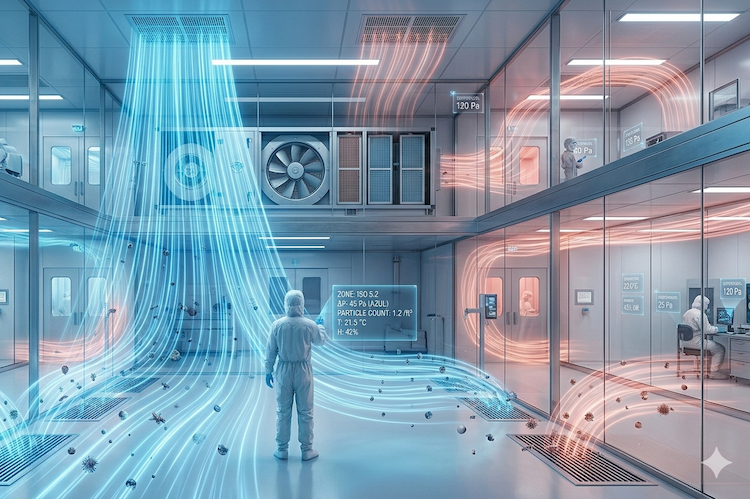
HVAC systems incorporate HEPA or ULPA filters that capture up to 99.999% of microscopic particles. Filtered air is pushed into the room through laminar diffusers, creating a constant flow that carries particles toward the return grilles.
2. Controlled airflow
Air can circulate in a laminar (unidirectional) or turbulent (multidirectional) manner. Laminar flow is used in critical zones (ISO 5-6), where a constant air direction must be maintained. Air velocity and the number of air changes per hour are key parameters for maintaining the desired cleanliness level.
3. Control of internal sources
Particles can also be generated inside the room by staff movement, or the use of incompatible materials or equipment. That’s why clothing, cleaning and maintenance protocols are applied to prevent the generation and buildup of particles.
Pressure control in controlled environments
Pressure control is the other fundamental pillar of a clean environment. It is used to direct airflow and prevent the entry or escape of contaminants between different zones. Each area of the facility maintains a different pressure, creating a pressure gradient that ensures correct air direction.
Types of pressure: strategy for control and safety
| Room type | Pressure type | Objective |
|---|---|---|
| Sterile cleanroom | Positive pressure | Prevents the entry of contaminated air from less-clean zones. |
| Biological or chemical containment room | Negative pressure | Prevents contaminants from escaping outside. |
| Intermediate zones or airlocks | Neutral or balanced pressure | Facilitates transition between areas of different classification. |
The typical pressure difference between adjacent zones is usually 10 to 15 Pa, sufficient to ensure airflow direction without generating turbulence.
Continuous monitoring: real-time traceability and safety
Modern controlled environments integrate cleanroom control and instrumentation systems, enabling continuous real-time monitoring of particle levels, temperature, humidity and pressure.
Among the most commonly used equipment are:
- Optical or laser particle counters.
- Differential pressure sensors.
- Airflow and flow rate transducers.
- Logging and alarm software (BMS or SCADA).
These systems generate traceable reports and alert to any deviation from defined parameters, ensuring compliance with ISO and GMP standards.
Validation of particle and pressure control
Before a cleanroom is commissioned, and periodically afterward, validation tests are carried out to confirm the system’s effectiveness.
Notable examples include:
- Particle count test (according to ISO 14644-1).
- HEPA/ULPA filter integrity test.
- Differential pressure testing.
- Airflow visualization using smoke.
Results must comply with established limits and be documented for audits or regulatory inspections.
Benefits of effective control
Implementing an efficient particle and pressure control system provides key advantages:
- Guaranteed regulatory compliance (ISO, GMP, FDA).
- Reduced risk of cross-contamination.
- Greater safety for staff and product.
- Energy savings through smart air control.
- Continuous environmental stability during production.
At Ingenic, we integrate monitoring, filtration and pressure control systems into the design of our turnkey cleanrooms, ensuring maximum reliability and traceability on every project.
Without precise management of air and differential pressures, it is not possible to maintain classification or comply with international regulations.
Particle and pressure control is the foundation of every controlled environment. Without precise management of air and differential pressures, it is not possible to maintain cleanliness conditions or comply with international regulations.
At ISL Salas Limpias, we design and install HVAC and environmental monitoring systems to guarantee absolute control of particles, temperature and pressure in certified cleanrooms.
Contact us and we’ll help you create a safe, efficient environment compliant with ISO 14644 regulations.