
Cleanroom maintenance and cleaning: a basic guide for companies
Cleanroom maintenance and cleaning is just as important as its design and construction. A poorly maintained cleanroom can quickly lose its ISO classification, compromise product safety, and even lead to regulatory penalties.
For companies in sectors such as veterinary, pharmaceutical, cosmetic, food or healthcare, keeping cleanrooms in optimal condition is a mandatory requirement, both for quality reasons and regulatory compliance.
In this basic guide, we explain how to carry out cleanroom maintenance and cleaning, which protocols to apply, and which mistakes to avoid in order to guarantee a safe environment compliant with international regulations.
Why is cleanroom maintenance essential?
A cleanroom is not a static space: its effectiveness depends on continuous, controlled operation. That’s why maintenance and cleaning are fundamental pillars for:
- Regulatory compliance: Standards such as ISO 14644 and GMP require documented, ongoing maintenance. Without it, your certification is at risk.
- Product safety: Proper maintenance prevents contamination that could compromise the quality and safety of medicines, food or medical devices.
- Cost reduction: Prevention through regular maintenance is far more cost-effective than repairs following major failures.
- Extended lifespan: A well-maintained cleanroom can last decades in optimal condition.
Types of cleanroom maintenance
Different types of maintenance are applied to ensure proper operation:
- Preventive maintenance: Aims to anticipate failures through scheduled inspections and reviews, such as periodic replacement of HEPA and ULPA filters or verification of differential pressures.
- Corrective maintenance: Applied when a breakdown or unexpected failure occurs, such as repairing air conditioning systems or replacing light fixtures in cleanrooms — key elements within electrical and lighting installations for cleanrooms.
- Predictive maintenance: Increasingly used thanks to technology. Through sensors and data analysis, intervention timing can be optimized and component failures anticipated.
Cleaning white rooms: basic protocols
Cleaning is not a minor task, but a rigorous process that requires following strict protocols.
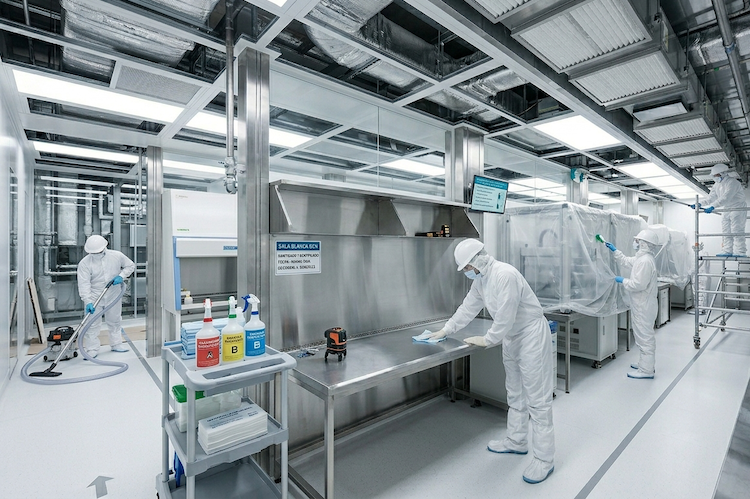
- Staff in charge: Personnel must be trained and required to wear sterile clothing and PPE (Personal Protective Equipment). Every cleaning operation must be documented.
- Cleaning frequency: Depends on the ISO classification level and sector. As a general rule, daily cleaning of floors and surfaces, weekly cleaning of walls, and monthly cleaning of ceilings and ventilation systems is recommended.
- Approved products and materials: Neutral detergents and disinfectants specific to controlled environments should be used, along with lint-free cloths and mops.
- Cleaning procedures: The golden rule is to always clean from top to bottom (ceiling → walls → floors) and from the cleanest zone to the least clean.
For more information, you can check our article on white room classification according to ISO 14644.
Applicable regulations for maintenance and cleaning
Maintenance and cleaning of white rooms are regulated by several standards. The most important are:
- ISO 14644-5: Specific to cleanroom operations, it sets out guidelines for cleaning, clothing and procedures.
- GMP: Requires written cleaning and maintenance protocols, as well as records accessible for audits.
- FDA: Regulates quality control in the manufacture of medicines and medical devices in the US, requiring compliance with cleaning protocols.
Failure to comply with these regulations can result in loss of certification and significant financial penalties.
Equipment and systems to maintain regularly
A maintenance plan must cover all key components of the cleanroom:
- HVAC and filtration: Periodic filter replacement, airflow calibration, and temperature and humidity control.
- Surfaces and furniture: Inspection of joints and seals, and disinfection of furniture with compatible products.
- Instrumentation and control: Sensor calibration and verification of monitoring systems to guarantee reliable data.
Cleanroom maintenance and cleaning is essential to ensure these spaces maintain their ISO classification and comply with GMP regulations. A well-planned maintenance strategy ensures safer processes, prevents contamination risks, and strengthens the confidence of clients and regulatory bodies.
Frequently asked questions about maintaining and cleaning white rooms
How often should a white room be cleaned?
It depends on the ISO classification, but generally daily cleaning of surfaces, weekly cleaning of walls, and periodic cleaning of ceilings and systems is carried out.
What products are used to clean white rooms?
Neutral detergents and specific disinfectants are used, along with materials that do not generate particles.
What happens if proper maintenance is not carried out?
The room may lose its ISO classification, increase the risk of contamination, and fail to comply with regulations such as GMP.
What does white room maintenance include?
It includes HVAC system checks, filter replacement, pressure control, surface cleaning and equipment calibration.
At ISL Salas Limpias we offer complete design, construction, maintenance and validation solutions for white rooms. Contact us to ensure your installation always meets the most demanding standards.