
HEPA and ULPA filters are essential components in the design and operation of cleanrooms, as they keep the air free of particles and contaminants.
Without them, it would not be possible to achieve the purity levels required by ISO 14644, GMP or FDA standards. We’ll explain what HEPA and ULPA filters are, what their differences are, and how to properly maintain them to guarantee your cleanroom’s optimal performance.
What HEPA and ULPA filters are
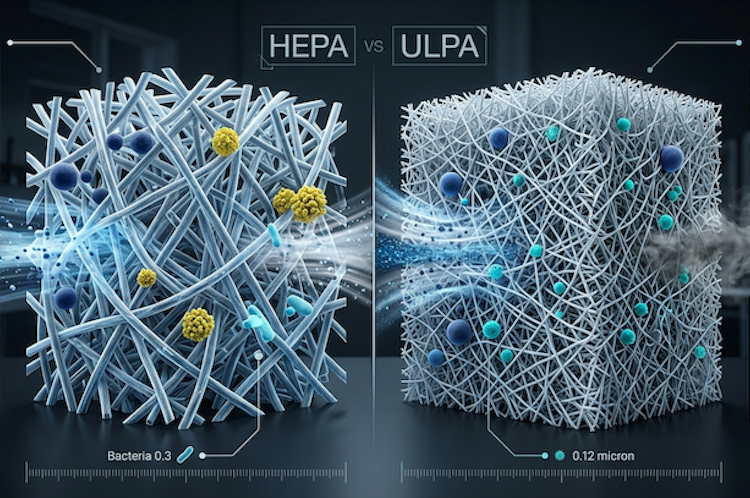
Both HEPA filters (High Efficiency Particulate Air) and ULPA filters (Ultra Low Penetration Air) are high-efficiency filtration systems designed to capture microscopic particles suspended in the air.
Their main function is to purify the air entering the cleanroom, ensuring the environment meets the cleanliness levels established by regulations.
These filters are used in combination with HVAC and laminar flow systems, which distribute clean air in a controlled, uniform manner.
Comparison table: efficiency and application of HEPA vs. ULPA filters
Although both types of filters share a common goal — removing contaminating particles — they differ technically in their retention capacity and application.
| Characteristic | HEPA Filter | ULPA Filter |
|---|---|---|
| Meaning | High Efficiency Particulate Air | Ultra Low Penetration Air |
| Minimum efficiency | 99.97% for particles ≥ 0.3 µm | 99.999% for particles ≥ 0.12 µm |
| Typical applications | Laboratories, pharmaceutical industry, hospitals (ISO 7-8). | Critical ISO 4–5 areas, microelectronics, optics, biotechnology. |
| Operating pressure | Lower | Higher (requires more powerful fans). |
| Cost and maintenance | More affordable and easy to replace. | More expensive, used in the most demanding zones. |
In short, ULPA filters offer superior filtration capacity, but also involve higher energy and maintenance costs. That’s why their use is reserved for environments where air purity must be extreme.
How HEPA and ULPA filters work
Both filters use the same physical particle-retention principle, based on three main mechanisms:
- Inertial impaction: large particles become trapped as they collide with the filter fibers.
- Interception: medium-sized particles adhere to the fibers as they pass close to them.
- Diffusion (Brownian motion): the smallest particles move erratically and end up trapped through contact with the fibers.
Their most penetrating particle size (MPPS) is the hardest to filter, and this is the size used to measure their real minimum efficiency. The result is clean, particle-free air, which is then distributed through laminar flow systems to maintain uniformity throughout the room.
Filter placement in a cleanroom
HEPA or ULPA filters are installed at strategic points in the HVAC system:
- In the ceiling or air diffusers, to ensure that the air introduced into the room is clean.
- In laminar flow cabinets or biological safety cabinets, where localized protection is required.
- In return or recirculation ducts, acting as secondary filters that maintain air purity within the system.
The location and type of filter depend on the cleanliness level (ISO class) and the type of process carried out in the facility.
Applicable regulations
HEPA and ULPA filters must comply with international manufacturing and validation standards, including:
- EN 1822 / ISO 29463: classification and testing of high-efficiency filters.
- ISO 14644: standards for the design and validation of cleanrooms.
- GMP / FDA: specific requirements for pharmaceutical and healthcare facilities.
These regulations guarantee the efficiency, traceability and safety of installed filtration systems.
Without HEPA or ULPA filters, it is not possible to achieve the purity levels required by ISO 14644, GMP or FDA in a cleanroom.
Preventive maintenance: key to ISO and GMP certification
Documented preventive maintenance is essential for preserving the effectiveness of HEPA and ULPA filters. The recommended practices are detailed below:
1. Periodic inspection
Filters should be visually inspected and tested for integrity at least once a year, or more frequently depending on use and sector. Any damage, deformation or loss of airtightness can compromise the room’s ISO class.
2. Differential pressure checks
Pressure gauges or sensors should be installed before and after the filter. A significant increase in pressure indicates particle buildup and the need for replacement.
3. Controlled replacement
Replacement of HEPA or ULPA filters must be carried out under controlled conditions, using decontamination procedures and sterile tools. The new filter must be validated through leak and airflow testing.
4. Cleaning and surroundings
During maintenance, frames, seals and nearby surfaces should be cleaned with non-corrosive disinfectant products. In addition, specific clothing and protective equipment are recommended to prevent the introduction of contaminants.
Signs that a filter needs replacement
- Loss of airflow or increased differential pressure.
- Particles detected by the environmental monitoring system.
- Leaks in the filter frame’s seals or joints.
- Visible physical damage (cracks, deformation or corrosion).
- Exceeding the manufacturer’s maximum recommended lifespan.
Ignoring these signs can affect the room’s ISO classification and put production processes at risk.
Benefits of good maintenance
Keeping HEPA and ULPA filters in optimal condition offers direct advantages:
- Continuous regulatory compliance (ISO, GMP, FDA).
- Energy savings and extended HVAC system lifespan.
- Reduced costs from unplanned downtime.
- Protection of the product, staff and environment.
- Improved quality and process traceability.
At ISL Salas Limpias, we carry out maintenance and validation of HEPA and ULPA filters, ensuring cleanrooms maintain their performance and certification over time.
HEPA and ULPA filters are the heart of a cleanroom’s ventilation system. Choosing the right type, installing them correctly and performing regular maintenance are essential to guarantee air purity and compliance with international regulations.
At ISL Salas Limpias, we offer comprehensive solutions for the design, installation and validation of filtration systems and turnkey cleanrooms, adapted to each sector and need.
Contact us for advice on HEPA and ULPA filters and specialized maintenance.