
Personnel are the main source of particles. That’s why contamination control in a cleanroom requires strict access mechanisms, in which air showers and biosafety systems play a crucial role. This equipment protects the environment and prevents the introduction of particles or microorganisms, guaranteeing the integrity of certified rooms.
Among these, air showers and biosafety systems play a crucial role in protecting the environment and preventing the introduction of particles or microorganisms.
Here we explain what air showers are, how they work, and how biosafety systems guarantee the integrity of cleanrooms certified under ISO 14644 and GMP.
What are air showers
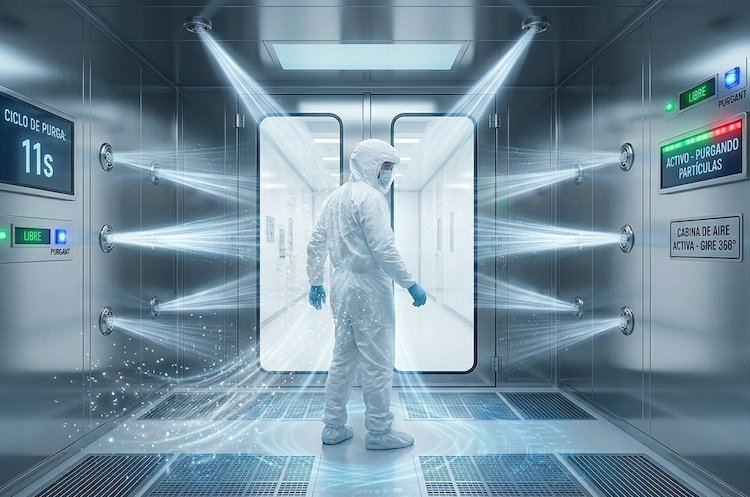
Air showers are enclosed cabins installed at the entrances to cleanrooms.
Their function is to remove contaminating particles that may adhere to clothing, hair or personnel equipment before entering the controlled area.
These showers project jets of high-speed filtered air (typically between 20 and 30 m/s) that dislodge particles from surfaces, preventing them from entering the clean environment.
Decontamination cycle: how the air shower works
An air shower operates on a rapid, automated purification cycle:
1. Entry and airtight closure:
The user enters the cabin and the doors close automatically to maintain pressure and prevent the entry of outside air.
2. Injection of filtered air:
Jets of clean air from HEPA or ULPA filters are expelled from nozzles strategically located on the walls and ceiling.
3. Dislodging and filtration:
Dislodged particles are drawn toward return grilles, where they are captured again by HEPA filters before the air is recirculated.
4. Release and opening:
Once the cycle is complete (15 to 30 seconds), the doors unlock and the user can enter the clean zone.
The system is designed so that the two doors never open simultaneously, preserving the pressure differential between zones.
Types of air showers
1. Air showers for personnel
These are the most common and are installed between the gowning area and the main entrance to the cleanroom. They allow personnel clothing to be decontaminated without physical contact or the use of chemical products.
2. Air showers for materials
Designed for equipment, carts or bulky products. They can be integrated with cleanroom pass-through systems and laminar flow control to maintain environmental purity while materials are in transit.
3. Combined showers
Combine personnel and material air systems within the same modular structure, separated by differential pressure zones.
Benefits of air showers in cleanrooms
- Significant reduction of external particles.
- Maintenance of positive pressure within the clean environment.
- Prevention of cross-contamination between areas.
- Time savings and increased productivity, thanks to automatic cycles.
- Compliance with ISO 14644, GMP and FDA regulations.
In addition, air showers extend the lifespan of HEPA filters by reducing the particle load entering the HVAC system.
Biosafety systems: BSL/NB containment and protection
Biosafety systems encompass a set of measures, equipment and procedures designed to prevent exposure to biological agents or contaminants within a cleanroom or laboratory.
Their application depends on the level of biological risk (BSL or NB) and the type of process. In pharmaceutical production or research environments, biosafety systems are integrated directly with HVAC, filtration and access control infrastructure.
Biosafety systems: BSL/NB containment and protection
- Biological safety cabinets (BSC): equipment with HEPA filters that protect the operator, the product and the environment, ensuring containment of biological agents.
- Controlled differential pressure: use of positive or negative pressure depending on the type of laboratory or process (for example, negative pressure in containment zones).
- Independent ventilation systems: ensure that contaminated air is filtered before being expelled outside.
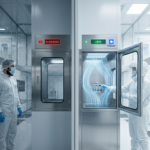
- Air vestibules and safety airlocks: allow safe transitions between clean and non-clean zones, complementing the operation of showers and pass-through boxes.
Cleaning protocols and periodic validation: include filter integrity tests, smoke tests and particle monitoring.
Difference between air showers and biosafety airlocks
Although both systems are installed at controlled access points, their function differs:
| Characteristic | Air showers | Biosafety airlocks |
|---|---|---|
| Purpose | Remove physical particles from personnel or materials. | Contain or prevent the spread of biological agents. |
| Type of air | Filtered, recirculated air with HEPA filters. | Extraction air under negative pressure. |
| Key regulation | ISO 14644 (cleanliness classification) | EN 12469 / BSL (biological containment) |
In many cases, both systems work together, especially in facilities that combine cleanliness and biosafety requirements.
Maintenance and validation
Air showers and biosafety systems must undergo periodic reviews to ensure their effectiveness:
- Inspection of HEPA filters and seal gaskets.
- Checking differential pressure.
- Verification of the door interlock system.
- Cleaning and calibration of flow sensors.
- Airflow visualization testing (smoke test).
A documented annual validation guarantees compliance with ISO 14644, GMP and EN 12469 standards (for biological safety cabinets).
Personnel are the main source of particles, and without controlled access systems no cleanroom can guarantee its integrity.
Air showers and biosafety systems are essential components for protecting both the environment and the personnel working in a cleanroom.
Their correct integration into the design guarantees contaminant containment, operational safety and regulatory compliance.
At ISL Salas Limpias, we design and install custom air showers, airlocks and biosafety systems, adapted to the requirements of each sector and risk level.
Contact us for advice on biosafety solutions for your cleanroom.