
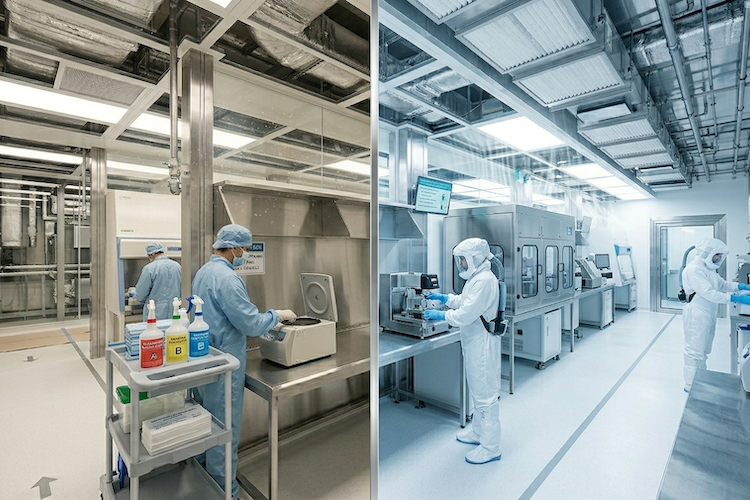
The terms white room and cleanroom (or clean room) are often used as synonyms, but in technical and regulatory contexts they actually carry important nuances. Both refer to controlled environments, essential in industries where air purity and environmental conditions determine the quality of the final product.
Today we clearly explain the difference between a white room and a cleanroom, how they are classified according to the ISO 14644 standard, and the role they play across different industrial sectors.
What a cleanroom is
A cleanroom is an enclosed space where the concentration of suspended particles is controlled, along with other parameters such as temperature, humidity, pressure or airflow.
These rooms are built following international classification standards (ISO 14644, GMP, FDA) that define the maximum permitted particle limits per cubic meter of air.
The term cleanroom is the more generic one and applies to any environmentally controlled space intended to protect sensitive processes or high-precision products.
What a white room is
The term white room is more common in Spanish-speaking countries and is typically used to refer to a high-demand cleanroom — that is, one belonging to the lowest, most critical ISO classes (for example, ISO 5 or ISO 6).
In this type of environment, design, filtration and cleanliness requirements are stricter:
- Laminar airflows are used, minimizing turbulence.
- High-efficiency HEPA or ULPA filters are installed.
- Materials are completely smooth, washable and free of visible joints.
- Staff must follow sterile access and clothing protocols.
Therefore, although both terms can refer to the same type of installation, a white room usually implies a higher level of purity and environmental control. Think of the cleanroom as a standard operating room and the white room as a maximum-security isolation room.
Comparison table: cleanroom vs. white room (technical highlights)
| Characteristic | Cleanroom | White Room |
|---|---|---|
| Definition | Environment with control of particles, temperature and humidity. | Ultra-clean environment, with strict control of particles and pressure. |
| Cleanliness level (ISO 14644) | ISO 7–8–9 (medium or basic levels). | ISO 4–5–6 (high or critical levels). |
| Common applications | Food, cosmetics, general electronics industry. | Pharmaceutical, biotechnology, microelectronics, research laboratories. |
| Air system | Turbulent or mixed flow. | Unidirectional laminar flow. |
| Air pressure | Moderate, may vary by zone. | Positive and constant to prevent contamination. |
| Equipment | Standard HEPA filters, technical furniture. | ULPA filters, antistatic materials, stainless steel and phenolic resin. |
| Main regulations | ISO 14644, basic GMP. | ISO 14644, advanced GMP, FDA. |
In short, every white room is a cleanroom, but not every cleanroom meets the conditions necessary to be considered a high-demand white room.
ISO 14644 classification: the particle threshold that defines the difference
The ISO 14644-1 standard classifies cleanrooms according to the maximum number of particles per cubic meter. The lower the ISO number, the higher the degree of cleanliness.
| ISO Class | Particle size (≥0.5 µm) permitted per m³ | Cleanliness level |
|---|---|---|
| ISO 5 | 3,520 | Very high (white room) |
| ISO 6 | 35,200 | High (white room) |
| ISO 7 | 352,000 | Medium (cleanroom) |
| ISO 8 | 3,520,000 | Basic (cleanroom) |
This system allows rooms to be designed and validated according to the specific requirements of each process or product.
Complementary regulations: GMP and FDA
In addition to ISO 14644, Good Manufacturing Practices (GMP) and FDA regulations define additional requirements in the pharmaceutical and healthcare industry.
These regulations govern aspects such as:
- Frequency of air renewal.
- Microbiological control of surfaces and equipment.
- Staff clothing and access procedures.
- Periodic cleaning and validation of spaces.
That’s why, when referring to a GMP white room, it means an environment validated under the strictest standards of purity and control.
Examples of cleanroom and white room use
- ISO 8 cleanroom: packaging or handling area for non-sterile products.
- ISO 5 white room: research laboratory or production of injectable medicines.
- ISO 7 cleanroom: electronic device assembly area.
- ISO 6 white room: production of high-end cosmetics or optical microcomponents.
Each sector defines its own requirements, but all share the need to maintain controlled, safe and certified environments.
Broadly speaking, the difference between a white room and a cleanroom lies in the level of environmental control and the type of process they are intended for, with white room typically being the term used to describe the highest level of demand and purity.
Both are essential to guarantee quality, safety and regulatory compliance in highly specialized industries.
At ISL Salas Limpias, we design and install custom cleanrooms and white rooms, complying with ISO, GMP and FDA standards, with turnkey solutions that guarantee efficiency, reliability and sustainability.