

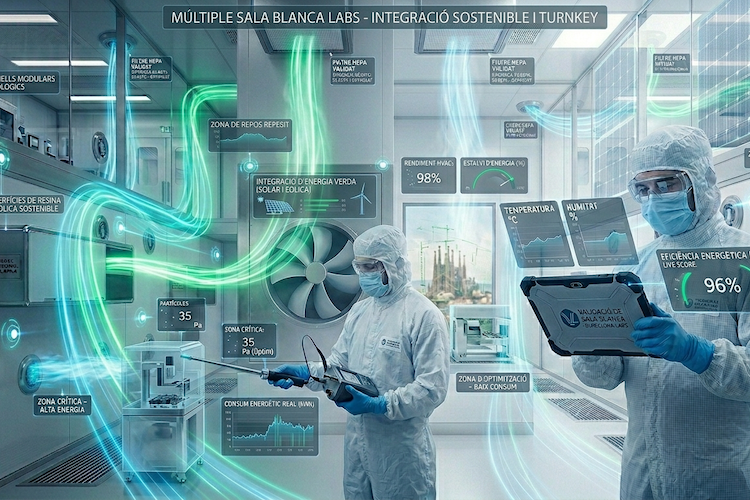
Innovation in cleanroom engineering has redefined the sector: from purely technical environments, we are moving toward sustainable smart cleanrooms. The goal is to reduce environmental impact without compromising air quality (ISO 14644) or process safety (GMP).
In this article we look at how innovation in cleanroom engineering is transforming the sector, integrating new technologies, materials and sustainable strategies that are paving the way toward the future.
The new generation of cleanrooms
Traditionally, design focused on complying with ISO 14644 and GMP standards. However, today companies are seeking efficiency, flexibility and sustainability, integrating eco-friendly design criteria from the earliest phases of the project.
This new generation of cleanrooms combines:
- Energy efficiency and low environmental impact.
- Automation and intelligent control.
- Recyclable, durable materials.
- Modular, scalable designs.
- Digital integration with industrial management systems.
1. Energy efficiency as a driver of innovation
Energy efficiency remains one of the biggest challenges in cleanroom engineering. HVAC systems account for up to 70% of total consumption, so advances are focused on:
- Fans with variable frequency drives (VFD) that adjust flow according to workload.
- Heat recovery units that harness energy from exhaust air.
- Automatic variable air volume control (VAV) to reduce airflow in idle mode.
- Continuous monitoring to optimize pressure, temperature and humidity.
- Integration of renewable energy, such as solar panels or geothermal systems.
These innovations can reduce energy consumption by up to 40%, without affecting the ISO class or process safety.
2. Digitalization and intelligent control
Digitalization has revolutionized the management of controlled environments. Modern systems integrate smart sensors, IoT (Internet of Things) and monitoring software (BMS or SCADA) that allow every parameter to be controlled in real time.
Advantages of intelligent control:
- Automatic adjustment of pressures and flows according to occupancy.
- Immediate detection of deviations in particles or temperature.
- Data logging and traceability for ISO and GMP audits.
- Predictive maintenance through data analysis, optimizing ROI and equipment lifespan.
This automation increases reliability, improves efficiency and reduces operating costs, bringing cleanrooms closer to the concept of smart facilities (Smart Cleanrooms).
3. Modular, flexible design
Another key trend in innovation is modular design. Modular construction systems allow a cleanroom to be assembled, expanded or modified quickly and without affecting existing operations.
Advantages of modular design:
- Reduced installation time.
- Less construction waste generated.
- Easy reconfiguration in response to process or regulatory changes.
- Compatibility with recyclable panels and hygienic materials.
At ISL Salas Limpias, for example, we work with modular structures made of sandwich panels and anodized aluminum framing, guaranteeing airtightness and thermal efficiency.
4. Low-impact materials: durability and life cycle
The materials used in cleanroom construction are evolving toward more eco-friendly, lower-impact solutions.
Notable examples include:
- Panels with natural rock wool or eco-friendly PIR core.
- Coatings with solvent-free antibacterial finishes.
- Low-VOC (volatile organic compound) phenolic and epoxy resins.
- Recycled aluminum and reusable stainless steel.
In addition to being sustainable, these materials offer greater durability and chemical resistance, reducing the need for replacement and maintenance.
5. Sustainability-driven engineering
Sustainability is no longer just an environmental issue, but a technical and economic criterion within cleanroom engineering. Today, projects are designed under the concept of the “sustainable cleanroom,” which integrates:
- Passive design: thermal optimization, use of natural light and advanced insulation.
- Life Cycle Assessment (LCA): analysis of environmental impact from manufacturing through operation.
- Environmental certifications: such as LEED, BREEAM or ISO 14001.
- Efficient water and waste management.
These strategies reduce the carbon footprint and guarantee long-term operational viability.
6. Integration with global trends: innovation and industrial sustainability
Cleanroom engineering is part of a broader movement: the transition toward a sustainable, digital industry.
Among the most notable innovations:
- Smart particle and flow sensors.
- Energy-efficient cabinets.
- Self-cleaning or antimicrobial materials.
- Plasma purification or advanced ionization systems.
- Digital Twins for simulation and predictive maintenance.
All of this positions cleanroom engineering as a pillar of industrial sustainability.
Innovation in cleanrooms is no longer measured only in particle control, but in its ability to reduce environmental impact without compromising performance.
Broadly speaking, the difference between a white room and a cleanroom lies in the level of environmental control and the type of process they are intended for, with white room typically being the term used to describe the highest level of demand and purity.
Both are essential to guarantee quality, safety and regulatory compliance in highly specialized industries.
At ISL Salas Limpias, we design and install custom cleanrooms and white rooms, complying with ISO, GMP and FDA standards, with turnkey solutions that guarantee efficiency, reliability and sustainability.
Contact us to design an innovative, sustainable cleanroom tailored to your sector and needs.